Saturday, August 3, 2013
Here we are back in Minot, North Dakota. Our trip from here and back has been great. First to Glacier National Park, then to Rathdrum, Idaho and Twinlow Camp, a quick trip to Poulsbo, Washington to visit some friends, then to Yellowstone and Grand Teton National Parks, on to Cody, Wyoming to see Buffalo Bill, next to Custer, South Dakota to see four presidents with big heads, and one mighty Indian carved in stone then a drive through the Badlands National Park. We left Custer Thursday morning headed back to Minot.
The time we have spent in all of our stops has been really great. We met a lot of really neat people along the way. We even met some good ole southerners while traveling. I think one of the neatest things we saw were all of the motorcyclist on the roads, and in the towns. We had a chance to meet many of them and talk about their travels. Most were in Montana, Wyoming, and South Dakota for the many Rallies held in just about every little town. Of course, the biggest in Sturges, South Dakota. We did take a drive on what is called the Iron Mountain Highway on one outing. Prior to getting on this 17 mile curvy highway, we stopped at a little place for some ice cream. It was a gathering point for the bikers, prior to, and after their ride on the Iron Mountain. Many were wearing T-shirts with wording about the highway having 311 curves in 17 miles. I don't know what is so great about that, there is a highway from Tennessee into North Carolina, that has 318 curves in 11 miles. Now that I have driven both, the one in Tennessee/North Carolina, called the Tail of the Dragon, is a much more challenging drive. I drove a Mazda Miata across the Tail, what a drive that was. The Iron Mountain did not compare, but I was just driving a Chevy Sonic, not the same.
Well, enough of that, let me take you on a trip from Hardin to Custer.
We made a side trip off of the interstate to see Devils Tower. It is as awesome as this picture shows. We had planned on stopping at the park, but the cars, and motorcycles, were lined up a mile long at the entrance gate. So we got back on the road again, but we did get some good pictures.
We arrived in Custer a lot earlier that we had anticipated, so we took off to see the Crazy Horse Monument. The picture below does not do the size of the carving justice.
The carving of Crazy Horse's head is taller that the Statue of Liberty, the hole in the middle is ten stories high. You can see the markings on the stone where the head of the horse will be. Compare the size of the horse's ear with the hole in the mountain.
This model is what the carving will look like when completed. Lot of work to be done before it is completed.
The artist, sculpturer, Korczak Ziolkowski, wrote the poem below. He used many of Crazy Horse's words about the land in his poem.
This is smaller scale model of the horses head, and Crazy Horse's hand, pointing to the lands of the Indian.
On Tuesday we drove through the Custer State Park. I have to apologize for just a few pictures of the park. I took many pictures on my other camera of much of the beautiful scenery of the park, but when I put the SD card in the camera, it didn't go in all the way, thus no picture. Oh well, you will like these. There is a large herd of donkeys roaming part of the park. They are supposed to be wild, but you can see that they are pretty tame, and spoiled by the visitors to the park. Of course feeding them doesn't help keeping them wild. Most parks tell you not to feed the animals, but you are allowed to feed these donkeys.
Sharon had this follow her everywhere she went. No, it is not me, even though there is a little resemblance. We both like Frito's.
We did make it to Mount Rushmore. Again, this picture does not do the size justice. Very impressive.
We spent our last full day just walking around Custer. The pictures below are of painted buffalo statues. These statues are made of fiberglass and painted by area artist. Many of them will be auctioned off in September for a city fund raiser. Even Col. Custer likes them.
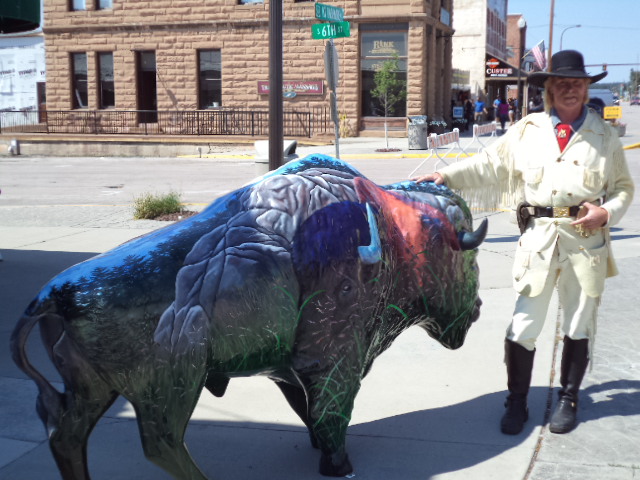
This one is a table top model. Pretty neat.
We found this clown behind a building in an alley way. Sharon said he looked familiar, what do you think.
We ate lunch on the patio atop of a restaurant on the main street of Custer. You can see some of the motorcycles parked along the street. Some of the were being blocked off for more motorcycle parking for the weekend.
We left Custer on Thursday morning for Minot. We took the long way so we could drive through the Badlands National Park. The Indians referred to this land as the "land bad". They saw it good for nothing. Later when French explorers first saw the land they changed it to "bad land".
You can see from the following pictures that there is not much there than sand and rock, with a little grass.
We made a brief stop at the visitor center.
Some people climbing to the top of one of the rock formations.
Miles and miles of nothing but bad lands.
But, just like everything, there is always a little beauty in sight.
After driving on curvy, mountainous roads, for about a month, I had a hard time keeping the motorhome in the road on the straight, long, roads in northern South Dakota and North Dakota. Also had our first rain in over a month.
We arrived in Minot yesterday, August 2nd, and will be here for four weeks. We are well rested and looking forward to going back to work.
I hope that you have enjoyed our trip for the past three weeks, we have enjoyed having you along with us.
I will let you all know what we are doing here in Minot later in the week. In the meantime, you all take care, and remember,
God Loves You
Gary
Monday, July 29, 2013
We arrived in Hardin, Montana Wednesday afternoon after a short drive from Cody, Wyoming. We arrived in time to visit the Little Big Horn Battlefield. For those of you that aren't familiar with Little Big Horn, that is where Lt. Col. Custer, and about 300 military officers and enlisted men, and several civilians, lost a battle against a large combined Indian force. Some refer to the battle as Custer's Last Stand. Custer was outnumbered by a much larger Indian force than was reported. There are many different ideas as to what happened on June 25 & 26, 1876, but no one really knows what transpired prior to the final fight.
The picture below is the memorial erected in memory of 220 men that were killed at Little Big Horn. There were others killed in battles around Little Big Horn that were buried in other locations.
This plaque tells when the remains of the soldiers were moved to the single site and placed in a mass grave. Officers were removed to cemeteries throughout the country.
The markers below indicate where the men under Custer's command were found on June 27, when General Cook, and the rest of the military force arrived at Little Big Horn. The marker in the middle with the black face is where Custer was found.
In 2002, a memorial to the Indians that gave there lives defending their way of life was dedicated. It was heralded as finally recognizing what the many Indian tribes had done to try a prevent the forced removal to reservations. It took five years after Little Big Horn for the last of the Indians that fought the battle surrendered, and moved onto reservations.
Also, about the same time, markers were placed at the places where several of the Indian Chiefs had died..
In 1886 a National Cemetery was started at Little Big Horn.
This is a view from the Little Big Horn Memorial overlooking the area where the Indians fought from.
On Friday morning we went of a sightseeing tour of the rest of the area around Hardin, Montana. We located a very nice little museum at the Hardin visitors center. The museum contains information about old Fort Custer, and early history on the city of Hardin.
Fort Custer was established just outside of where the town of Hardin is located. As you can see it only lasted for 22 years, longer than Custer's military career. There are many artifacts in the Hardin Museum from Fort Custer. Unlike many other old military forts on the frontier, there are no remaining structures of Fort Custer. One of the volunteers at the museum told us that there is a plaque at the original site that was placed there by the Daughters of the Revolution.
Here a couple of pictures of some of the artifacts that have been found, and some donated from ancestors of soldiers, located in the museum.
Outside on the grounds of the museum there are several buildings that have been relocated to the museum from other parts of the town, and county.
This is an original log cabin belonging to a settler in the town.
This railroad station was relocated from Lodge Grass, a town some twenty miles, or more, from Hardin.
This church was originally located in downtown Hardin. It was built in 1917. This building was replaced by a more modern one in 1947.
I just liked the barn full of old tractors.
Sharon found a seat that fits her. They were all too small for me.
The picture below is the Yellowtail Dam. The dam is located in the Big Horn National Park, about 40 miles from Hardin. The drive to the dam went through a lot of farm land. I told you all about our trip to the Heart Mountain Relocation Camp in Cody, well the Japanese that were there taught the farmers of Wyoming how to irrigate their land. Many canals were built along the rivers that took water to the fields. I saw acres and acres of wheat, corn, and sugar beets. There has not been any rain here in about three weeks, but with irrigation, the crops looked great. The wheat was being harvested.
We took off Saturday and rested. But, on Sunday we went to Pompeys Pillar for the Clark Days Festival. The Clark Days are named after William Clark, of the Lewis and Clark expedition of 1804 - 1806. Clark, and his men, were on a separate route from Lewis at the time he stopped at the pillar. I'll let you look up where the name came from, it's a long story.
This is a picture of the pillar. You can see on the right side, and half way up, the observation deck where you can see where W Clark chiseled his name into the stone.
It is well protected by being enclosed in glass. This is the only known such markings made by Clark on the expedition.
This is a view from the top of the pillar.
The two gentlemen below were giving demonstrations on loading and firing muskets and rifled black powder rifles. They did not load the guns with shot, but just fired the powder. Very interesting.
The picture below is the memorial erected in memory of 220 men that were killed at Little Big Horn. There were others killed in battles around Little Big Horn that were buried in other locations.
This plaque tells when the remains of the soldiers were moved to the single site and placed in a mass grave. Officers were removed to cemeteries throughout the country.
The markers below indicate where the men under Custer's command were found on June 27, when General Cook, and the rest of the military force arrived at Little Big Horn. The marker in the middle with the black face is where Custer was found.
In 2002, a memorial to the Indians that gave there lives defending their way of life was dedicated. It was heralded as finally recognizing what the many Indian tribes had done to try a prevent the forced removal to reservations. It took five years after Little Big Horn for the last of the Indians that fought the battle surrendered, and moved onto reservations.
Also, about the same time, markers were placed at the places where several of the Indian Chiefs had died..
In 1886 a National Cemetery was started at Little Big Horn.
This is a view from the Little Big Horn Memorial overlooking the area where the Indians fought from.
On Friday morning we went of a sightseeing tour of the rest of the area around Hardin, Montana. We located a very nice little museum at the Hardin visitors center. The museum contains information about old Fort Custer, and early history on the city of Hardin.
Fort Custer was established just outside of where the town of Hardin is located. As you can see it only lasted for 22 years, longer than Custer's military career. There are many artifacts in the Hardin Museum from Fort Custer. Unlike many other old military forts on the frontier, there are no remaining structures of Fort Custer. One of the volunteers at the museum told us that there is a plaque at the original site that was placed there by the Daughters of the Revolution.
Here a couple of pictures of some of the artifacts that have been found, and some donated from ancestors of soldiers, located in the museum.
Outside on the grounds of the museum there are several buildings that have been relocated to the museum from other parts of the town, and county.
This is an original log cabin belonging to a settler in the town.
This railroad station was relocated from Lodge Grass, a town some twenty miles, or more, from Hardin.
This church was originally located in downtown Hardin. It was built in 1917. This building was replaced by a more modern one in 1947.
I just liked the barn full of old tractors.
Sharon found a seat that fits her. They were all too small for me.
The picture below is the Yellowtail Dam. The dam is located in the Big Horn National Park, about 40 miles from Hardin. The drive to the dam went through a lot of farm land. I told you all about our trip to the Heart Mountain Relocation Camp in Cody, well the Japanese that were there taught the farmers of Wyoming how to irrigate their land. Many canals were built along the rivers that took water to the fields. I saw acres and acres of wheat, corn, and sugar beets. There has not been any rain here in about three weeks, but with irrigation, the crops looked great. The wheat was being harvested.
We took off Saturday and rested. But, on Sunday we went to Pompeys Pillar for the Clark Days Festival. The Clark Days are named after William Clark, of the Lewis and Clark expedition of 1804 - 1806. Clark, and his men, were on a separate route from Lewis at the time he stopped at the pillar. I'll let you look up where the name came from, it's a long story.
This is a picture of the pillar. You can see on the right side, and half way up, the observation deck where you can see where W Clark chiseled his name into the stone.
It is well protected by being enclosed in glass. This is the only known such markings made by Clark on the expedition.
This is a view from the top of the pillar.
The two gentlemen below were giving demonstrations on loading and firing muskets and rifled black powder rifles. They did not load the guns with shot, but just fired the powder. Very interesting.
We really enjoyed our time in Hardin, and the surrounding area. We are now getting ready to travel to Custer City, South Dakota. There we plan on seeing the Chief Crazy Horse sculpture, and Mount Rushmore. Until the next leg of our journey, you all take care, and remember,
God Loves You,
Gary
Friday, July 26, 2013
Monday was our last day in Yellowstone. We had a great visit to the most beautiful spot in the country. Yellowstone has everything, desert like terrain, rolling hills and green mountains, jagged rocky mountains, green grassy plains, and many hot springs and geysers. We will never forget this experience.
We left the RV park in Gardner early and made one more short trip through Yellowstone National Park on our way to Cody, Wyoming. We went through Lamar Valley again where we had seen the large herd of buffalo (bison) on Saturday. They were still there. I learned later that the valley is where the buffalo stay most of the time during the summer. One of the animals that we had really wanted to see was a grizzly bear. Well, we got to see one as we were leaving the park. The road was blocked with the many cars and people that had stopped to see the bear. Since we were driving the RV it was hard to stop, but we slowed enough to be able to see the bear walking along the river on the other side of the road. Couldn't even get a good picture since I couldn't stop. A park ranger came along and started making people move along, or at least get off of the road.
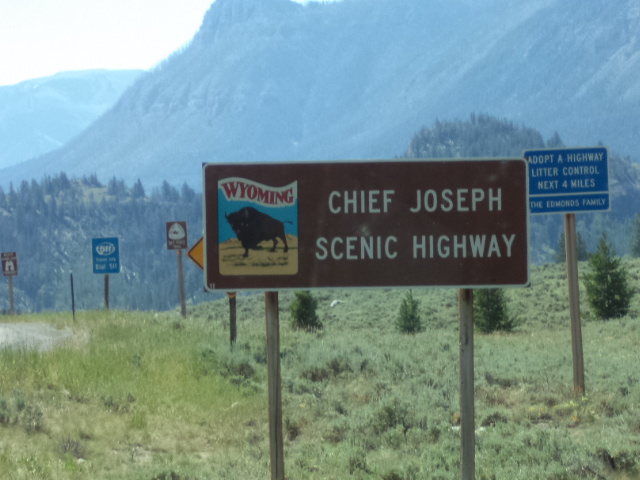
Shortly after leaving the park we got onto the Chief Joseph Scenic Highway headed for Cody.
I was pleasantly surprised to find the Chief Joseph Scenic Highway just as exciting as all of the other scenic highways that we had been on. This one was even more exciting since I was driving the RV, and towing the car. The highway started out nice and straight with few hills, but that changed soon. There were many turns in the road that I could see the car's rear license plate as we rounded them. Take a look for yourself.
The ride across the Chief Joseph was very pleasurable. There was very little other traffic on the road, so we were able to slow down and enjoy the scenery.
Welcome to Cody, Wyoming. Sharon and I have done all of the touristy things while here in Cody, so let me take you through a couple of days of sight seeing and play.
We started out our sightseeing soon after we arrived in Cody. The first thing that I wanted to see was the WWII internment camp where over 10,000 Japanese were interned right after the start of the war. I had read, and seen stories, about the internment of the Japanese living on the west coast after the US declared war on Japan, but had never really understood why, and the outcome and effect on the lives of those interned. The Heart Mountain Relocation Center housed over 10,000 people at one time, making it the 3rd largest city in Wyoming at that time. The site is now a National Historic Site. The visitor's center is built to resemble three of the large buildings that housed those that were interned there. There is so much to say about what happened here, and the many stories that came after, but I don't have the space, or time. I will just post a few pictures, and let you see some of it for yourself. If you really want to know more, take the time to search about that time in our history.
When those that were relocated to Heart Mountain, they found bare rooms for their families to move into. Depending on the size of the family, they were assigned a single room from 16' X 20', up to 20' X 24'. The only furnishings were cot type beds and mattresses.
Through hard work, and on their own self desire to better their conditions, those interned built furniture from what ever scraps could be found and made their rooms as comfortable as possible.
Even though the camps were called either relocation centers, or internment camps, they were more like prison or concentration camps. The camp was enclosed with fencing and guarded like any other prison camp.
Up on a hill behind the visitor's center is a memorial placed in remembrance of those that lived, and died, at Heart Mountain. It is amazing how many of those that were interned at Heart Mountain, and the other camps around the country, became very productive citizens of the US, including senators.
Here is the history of Heart Mountain.
The memorial site.
Prior to the beginning of the rodeo, these young ladies rode onto the arena with the American Flag. After an orchestrated ride, the girls stopped in the middle of the arena, we were all asked to rise as the National Anthem was played. The crowd joined in by singing the National Anthem. I thought that was the best, but it got better as the announcer then ask all to join him in prayer. He then prayed for the rodeo competitor's, the animals involved, and for those of us there to watch the rodeo. Really impressive. We had some visitors from Germany sitting behind us, they commented on how they thought this was a very good thing to do.
Then the action began. This bronco rider didn't last very long.
This guy stayed on for the full 8 seconds required. He went onto win the bronco competition.
They even had a 12 and under bull rider competition. Only one out of six riders was able to stay on the little bull for the 8 seconds. One of the riders was only 6. They are well padded and wear helmets.
This guy was riding a lot of wild bull.
Sharon is standing next to a large statue of Buffalo Bill.
The first area of the center that I went into was the large gun section. Sharon sat out in the lobby as I toured this area. There are weapons from the earliest ever made, to the latest. There was one musket from the 15th century that I know would take at least two people to hold. It looked very heavy and was over 8 feet long. The display below shows a sequence of muskets and rifles used in the exploration and settlement of the west.
There is a very good display of the plains Indians.
These clothes were actually worn by Bill Cody when he was chief of scouts for the army.
This chuck wagon, and cook, were outside the center. He had cooked some beans, biscuits, and coffee. We got to sample some of each. The beans and biscuits were very good, the coffee was really good. He said that the menu for drovers usually consisted of just beans, biscuits, and coffee. If the crew was big enough there might be beef added, but only if it all could be cooked at one time. Meat couldn't be kept fresh while on the trail drives.
Old Trail Town. This sign tells you about the town.
Town from the west end.
This cemetery is real. It contains the bodies of several famous mountain men, outlaws, and one woman. The character that Robert Redford played in the movie "Jeremiah Johnston" was based on a real person of the same name. His body was relocated here after the movie was made. Redford even attended the funeral.
Thought this was interesting. Along with this cabin, all of the other buildings had been moved from other locations to make the town. Several cabins, blacksmith shops, bar, livery stables, store, post office, and many more.
The Hole In the Wall Gang.
The river below the dam.
We left the RV park in Gardner early and made one more short trip through Yellowstone National Park on our way to Cody, Wyoming. We went through Lamar Valley again where we had seen the large herd of buffalo (bison) on Saturday. They were still there. I learned later that the valley is where the buffalo stay most of the time during the summer. One of the animals that we had really wanted to see was a grizzly bear. Well, we got to see one as we were leaving the park. The road was blocked with the many cars and people that had stopped to see the bear. Since we were driving the RV it was hard to stop, but we slowed enough to be able to see the bear walking along the river on the other side of the road. Couldn't even get a good picture since I couldn't stop. A park ranger came along and started making people move along, or at least get off of the road.
Shortly after leaving the park we got onto the Chief Joseph Scenic Highway headed for Cody.
I was pleasantly surprised to find the Chief Joseph Scenic Highway just as exciting as all of the other scenic highways that we had been on. This one was even more exciting since I was driving the RV, and towing the car. The highway started out nice and straight with few hills, but that changed soon. There were many turns in the road that I could see the car's rear license plate as we rounded them. Take a look for yourself.
The ride across the Chief Joseph was very pleasurable. There was very little other traffic on the road, so we were able to slow down and enjoy the scenery.
Welcome to Cody, Wyoming. Sharon and I have done all of the touristy things while here in Cody, so let me take you through a couple of days of sight seeing and play.
We started out our sightseeing soon after we arrived in Cody. The first thing that I wanted to see was the WWII internment camp where over 10,000 Japanese were interned right after the start of the war. I had read, and seen stories, about the internment of the Japanese living on the west coast after the US declared war on Japan, but had never really understood why, and the outcome and effect on the lives of those interned. The Heart Mountain Relocation Center housed over 10,000 people at one time, making it the 3rd largest city in Wyoming at that time. The site is now a National Historic Site. The visitor's center is built to resemble three of the large buildings that housed those that were interned there. There is so much to say about what happened here, and the many stories that came after, but I don't have the space, or time. I will just post a few pictures, and let you see some of it for yourself. If you really want to know more, take the time to search about that time in our history.
When those that were relocated to Heart Mountain, they found bare rooms for their families to move into. Depending on the size of the family, they were assigned a single room from 16' X 20', up to 20' X 24'. The only furnishings were cot type beds and mattresses.
Through hard work, and on their own self desire to better their conditions, those interned built furniture from what ever scraps could be found and made their rooms as comfortable as possible.
Even though the camps were called either relocation centers, or internment camps, they were more like prison or concentration camps. The camp was enclosed with fencing and guarded like any other prison camp.
Up on a hill behind the visitor's center is a memorial placed in remembrance of those that lived, and died, at Heart Mountain. It is amazing how many of those that were interned at Heart Mountain, and the other camps around the country, became very productive citizens of the US, including senators.
Here is the history of Heart Mountain.
The memorial site.
After our visit to Heart Mountain, we headed for downtown Cody, and the Cody visitor center. We picked up several brochures about several things to see in the Cody area. The two things we really wanted to see were the rodeo and the Cody Museum. We bought tickets for the rodeo and made plans for the museum.
We really had a great time at the rodeo. Here are just a few of the many pictures that I took.
Prior to the beginning of the rodeo, these young ladies rode onto the arena with the American Flag. After an orchestrated ride, the girls stopped in the middle of the arena, we were all asked to rise as the National Anthem was played. The crowd joined in by singing the National Anthem. I thought that was the best, but it got better as the announcer then ask all to join him in prayer. He then prayed for the rodeo competitor's, the animals involved, and for those of us there to watch the rodeo. Really impressive. We had some visitors from Germany sitting behind us, they commented on how they thought this was a very good thing to do.
Then the action began. This bronco rider didn't last very long.
This guy stayed on for the full 8 seconds required. He went onto win the bronco competition.
They even had a 12 and under bull rider competition. Only one out of six riders was able to stay on the little bull for the 8 seconds. One of the riders was only 6. They are well padded and wear helmets.
This guy was riding a lot of wild bull.
That was the end of a busy day. Next the Cody Museum.
Sharon is standing next to a large statue of Buffalo Bill.
The first area of the center that I went into was the large gun section. Sharon sat out in the lobby as I toured this area. There are weapons from the earliest ever made, to the latest. There was one musket from the 15th century that I know would take at least two people to hold. It looked very heavy and was over 8 feet long. The display below shows a sequence of muskets and rifles used in the exploration and settlement of the west.
There is a very good display of the plains Indians.
These clothes were actually worn by Bill Cody when he was chief of scouts for the army.
This chuck wagon, and cook, were outside the center. He had cooked some beans, biscuits, and coffee. We got to sample some of each. The beans and biscuits were very good, the coffee was really good. He said that the menu for drovers usually consisted of just beans, biscuits, and coffee. If the crew was big enough there might be beef added, but only if it all could be cooked at one time. Meat couldn't be kept fresh while on the trail drives.
We visited several other attractions as we continued to do the sight-seeing thing.
We saw a western town that had been built from re-located old buildings from around Wyoming. Let's take a walk around town.
Town from the west end.
This cemetery is real. It contains the bodies of several famous mountain men, outlaws, and one woman. The character that Robert Redford played in the movie "Jeremiah Johnston" was based on a real person of the same name. His body was relocated here after the movie was made. Redford even attended the funeral.
Thought this was interesting. Along with this cabin, all of the other buildings had been moved from other locations to make the town. Several cabins, blacksmith shops, bar, livery stables, store, post office, and many more.
The Hole In the Wall Gang.
We even took time to visit the Cody Dam. When the dam was built in the early 1900's it was the tallest dam in the world.
The lake above the dam.
The river below the dam.
We finished the week with a gun fight at the Irma Hotel. Bill Cody built the hotel in the early 1900's. It is still in operation as a hotel and restaurant.
The bad guys.
The good guys.
The good girls. Well at least they said they were.
We finished up the evening with a great steak dinner. I had a buffalo steak that was the best steak that I have had in a long time.
We left Cody Thursday morning headed for Hardin, Montana, and a visit to Little Big Horn. Stay buckled up for the next part of the trip.
I'll be back with that part of the trip in a couple of days, so remember
God Loves You.
Gary
Subscribe to:
Posts (Atom)